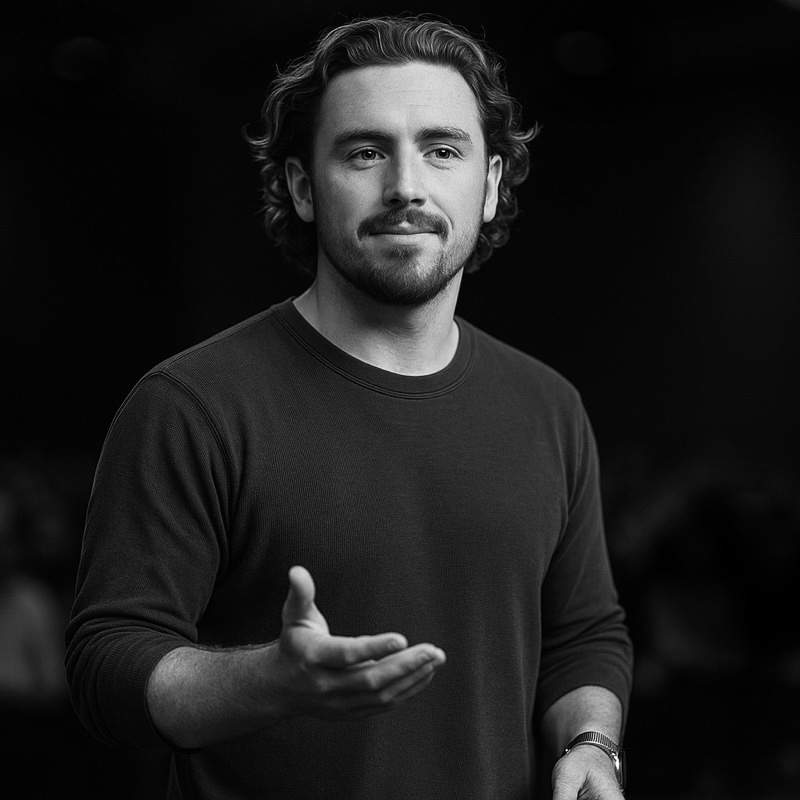
Black-and-white portrait of Mario Gryza

Mario Gryza

Connecting Business, Product & Technology

I build, simplify and transform products, systems and businesses. I am most drawn to problems without an obvious answer — where business, technology, people and execution have to come together.

Open to interesting opportunities and collaborations

10+years building businesses, products and systems
3locations built and run within my own business network, later sold
5,000+products in a managed e-commerce portfolio
100+CRM/ERP users across multiple companies
01

The story

BUSINESSES

01 / 04Customers, people, finance, operations and responsibility for the entire outcome.

PRODUCTS

02 / 04From physical products and e-commerce to digital solutions.

SYSTEMS

03 / 04Connecting people, data, processes and technology.

TRANSFORMATION

04 / 04Changing how a company actually works.

My professional path did not start in a corporate career. It started with building businesses.

I went directly into entrepreneurship after school. At first, I learned how a business works from the inside — through customers, people, operations, finance and brand.

Through e-commerce, physical product development and digital projects, I moved into end-to-end product leadership, internal systems and eventually the transformation of how companies operate.

Each chapter showed me a different part of the same system. Eventually, I became most interested in the spaces between disciplines — where understanding only one of them is not enough.

The problem is rarely exactly where the symptom first appears.

02

Selected work

Not every meaningful experience fits inside a job title. These three chapters best explain how I think today.

01 / 03

BUILD

Building from zero

My first years taught me entrepreneurship without any safe distance between a decision and its consequences. I built a network of three barbershops, managed people, operations, finance, marketing and customer experience. Later, I built an e-commerce business with more than 5,000 products and participated in developing a cosmetics brand. Both main entrepreneurial projects were later sold. Every decision eventually meets a real customer, person, process and real economics.

3 locations · 5,000+ products · businesses built and sold
02 / 03

PRODUCT

When a product becomes operating infrastructure

At Energo Synergy I had end-to-end responsibility for the design, development and scaling of an internal CRM/ERP ecosystem. It connected sales, project delivery, back office and management. The product evolved from discovery and strategy through module design, UX/UI, development coordination and testing to rollout across multiple companies for more than 100 users. Automation saved hundreds of hours every month.

100+ users · multiple companies · hundreds of hours saved each month
03 / 03

TRANSFORM

Efficiency is often invisible until you map it

At Inovision I work primarily with companies in energy, construction, real estate and project-delivery businesses. Across very different companies, a similar pattern repeats: the biggest opportunities for improvement are often not in individual people or tools, but in how processes, information and decision-making connect to one another.

That is why I do not start with technology, but with mapping how the company actually works. I look for places where unnecessary manual work, delays, duplication or blind spots emerge between people and systems. Only then does automation, integration or AI make sense — as a tool for simpler and more efficient operation, not as another layer on top of existing chaos.

processes · automation · AI · change
02 — What repeats

A company can look well organised from both the outside and the inside — experienced people, CRM systems, spreadsheets, meetings, reports and established processes — while still containing a surprising amount of hidden inefficiency.

Data gets copied.

Information lives in multiple places.

Decisions wait for specific people.

The same work gets repeated.

Processes exist because they have existed for years, while few people remember why.

Eventually the organisation starts treating this as normal.

My work begins by understanding the real process.

Only then does it make sense to redesign workflows, operating models, CRM systems, automation, reporting, internal tools or the use of AI.

In some projects we also work with local AI models and custom internal applications.

But the technical solution is only half of the work.

The other half is helping the organisation adopt the change — explaining why, involving teams, training people and creating a new way of working that lasts.

Career timeline

Founder & Managing Director

Cutcrew

People, customers, operations, finance and responsibility for the whole business.

Founder & E-commerce Manager

Woodmasters Store

E-commerce, logistics, marketing, data and managing a 5,000+ product portfolio.

Product & Brand Development

Omnigo

Physical product development, brand, production, regulation and go-to-market.

Digital Product Manager

Media Masters

Digital products, MVPs, UX/UI and the journey from concept to launch.

Head of Product

Energo Synergy Group

Product strategy, CRM/ERP and scaling a system across multiple companies.

Digital Transformation Lead

Inovision

Processes, automation, AI, data and transforming how companies operate.

AUTOMATINGCHAOSONLY MAKESCHAOS FASTER.

03

How I think

Experience taught me that good frameworks are useful, but reality rarely fits neatly inside one of them.

01

Cause before solution

I do not start with technology or a product feature. I first try to understand what is actually holding back the customer, team or business — and why.

02

Think in connections

Business, product, technology and operations each see a different part of the same problem. Value appears when we see them as one system.

03

Technology is leverage, not the objective

A new tool is not progress by itself. Technology matters when it improves decisions, people's work, customer experience or economics.

04

Change happens through people

Deploying a solution is not the same as changing an organisation. Change happens when people understand why and actually use a new way of working.

05

Simplicity that scales

I look for structures, processes and tools that reduce friction and allow a company to grow without letting chaos grow with it.

06

Context scales better than control

When people understand the goal, boundaries and principles for decisions, a good system creates autonomy without losing direction.

04

What shapes my thinking

My curiosity does not stop at products and companies. I keep returning to fields that change how people make decisions, work together and create value.

At first glance, these are different worlds. To me, they explore a similar question: how people and systems make decisions in environments we can never fully control.

01

Markets & economics

I have been investing since 2018 and actively trading since 2020. Markets taught me to separate decision quality from short-term outcomes, think in probabilities, manage downside risk and change my mind when the evidence changes.

02

Psychology & human behaviour

Many business problems are ultimately human problems: trust, motivation, status, fear, communication and identity. I am also drawn to deeper perspectives, including Jungian ideas around self-knowledge and individuation.

03

Technology & systems

As a child, I wanted to be an inventor. I am fascinated by the places where software, hardware and the physical world combine into something that did not exist before. Technology interests me because of what it makes possible.

04

Philosophy & learning

I return to questions of meaning, discipline, self-knowledge, growth and how we construct our view of the world. Not to find one correct answer, but to learn to ask better questions.

04.1

Ideas I carry between disciplines

Across different fields, I keep finding principles that remain useful far beyond the context in which I first encountered them.

01

Decision quality is not the same as the outcome

A good decision can produce a bad short-term result, while a bad decision can work for a while. I therefore try to judge the process, information and reasoning behind a decision — not one isolated outcome.

02

System before effort

Extra effort can solve today's problem. A well-designed system reduces the probability that the same problem has to be solved again tomorrow.

03

People are not a spreadsheet

A solution can be perfectly logical and still fail in practice. A company is both a system of processes and a system of human behaviour. Ignoring either side means misunderstanding the whole.

04

Direction before speed

Technology, automation and AI can multiply performance. They can just as easily multiply a badly designed process. Before accelerating something, I want to understand where the system should go and why.

— NEXT

What motivates me

I'm most motivated by roles and projects where something new is being created — a product, a system, a technology or a new way for a company to operate. Places where the problem doesn't yet have a ready-made answer. What matters more than a specific job title is the problem, the people and the chance to create real value.

05

Have something in mind where I could add value?

If reading this site made you think of a product, company, technology, role or collaboration where I could create value, send me a message. I would be happy to hear the context and see whether it makes sense to connect.